Archive | December, 2017

Post Script: developers probably never paid fees toward 99 or 32 widenings

5 Dec

Here’s an interesting read about developer fees, from 2013.

https://chicotaxpayers.com/2013/08/22/hwy-32-widening-will-caltrans-carry-out-their-threat-to-sue-us-because-we-didnt-collect-developer-fees/

I don’t know if those developers ever paid anything toward the widenings of Hwy 99 or Hwy 32, both of which were necessitated by their projects. It sounds like the city used RDA money to pay CalTRANs for the work.


Downtown Chico Jack in the Box installs bars “to protect employees…” – is Jack in the Box the problem with Downtown crime? Or Chico PD?

4 Dec

From Channel 7 News, in Redding:

http://www.krcrtv.com/news/local/butte/downtown-chico-jack-in-the-box-installs-bars-to-protect-employees/666968351

The first thing I noticed when I looked at the picture was, this isn’t about drinks and food being thrown, because those bars wouldn’t stop it. In fact, it reminds of the scene from “Blues Brothers” where the  boys play the cowboy bar, “protected” from the raucous mob of beer chucking music haters by nothing but chain link fencing. Jack in the Box employees will not be protected from flying tacos and drinks by these hokey bars.

But these bars might stop a person from jumping over the counter to attack and/or rob the employees. Well, what about law abiding customers? 

Jack in the Box staff are reluctant to blame “the homeless“, but as one customer observed, “There’s the park right over there and there’s a really large homeless population here and they specifically, a lot of them sleep over there or hang out over there…”

The story concludes, “So whether it’s the park, the downtown party crowd, or even just the average Joe that’s the source of the problems, staff said they think every downtown fast food spot in any city would have these same types of altercations. “

Really? Is that why the city of Chico installed bullet-proof glass at the Finance Office last year? 

Who is the problem here?  Should we allow 24 hour businesses Downtown, especially when they seem to be a consistent center of criminal activity? But wait a minute – Chico PD gets paid around the clock, including generous overtime allowances – why do we have a crime problem Downtown? 


Pensions before streets – business as usual in Chico California

3 Dec

The Finance Committee meeting I attended Wednesday (11/29/17) also included a discussion of “street urbanization fees.” The city of Chico supposedly requires developers to provide or pay for new curbs and gutters in existing neighborhoods whenever they build a new subdivision.

About 10 years ago the city approved a new subdivision in my neighborhood – in a former neighbor’s back yard – and despite the protests of our neighbors, gave the builder “variances” to just about everything in the city code. The result was seven houses where there was really only room for three or four. There is a constant turnover of residents and they all  bring lots of cars. A few days ago we noticed a giant moving van out on the street in front of the subdivision – there is absolutely no place to park a vehicle like that on their own street. In fact, there is no place for garbage trucks to turn around, they have to back out.

This was before the city even discussed “variable rates” for developers – see how they do what they want.

But no improvements were made on our main street, which has become a “feeder” or “through” street for all these little subdivisions that sprung up in Grandma’s back yard over the course of several building booms and busts.

Builder Chris Giampoli, who does a lot of CHIP housing, does not feel he should have to make those improvements when he shoves five CHIP houses into an existing neighborhood. Well, we’re not talking about the entire street, we’re just talking about curbing and guttering the feeder street where his new street breaks in. Giampoli opined that if the feeder is already crapped out, that’s from existing residents, and developers shouldn’t have to pay for bringing the street up to “current standards.”

What Giampoli and his friend Dan Gonzalez are suggesting through their “variable rates” ploy, is that existing residents subsidize their for-profit development business. Giampoli was one of five developers, along with Tom DiGiovanni, who got the permits for Gonzalez’ project at Meriam Park,  named in a lawsuit threatened by CalTrans, over subdivisions being built without fees being collected for the improvements recently made to highways 99 and 32.  According to Mark Sorensen, those developers have never paid fees toward those highway widenings, which their projects necessitated.  So beat it Chris, you been getting a free ride for too long there buddy. You couldn’t survive in the free market, like your dad did, cause you cut corners and build subsidized crap. Dan Gonzalez isn’t going to be able to sell Meriam Park without government hand-outs, and he knows it. These people expect the taxpayers to support them.

Let’s face it – developers bring people to our town, they use our neighborhoods – our town! –  to attract buyers, they should have to invest money into our neighborhoods.  We existing residents already pay for that service, it’s called “property taxes.” Our prop taxes are split 45 – 55 by the county and city,  the city of Chico gets roughly half our property taxes. What they do with it? Cause they sure as hell have not been spending my property taxes on my street.
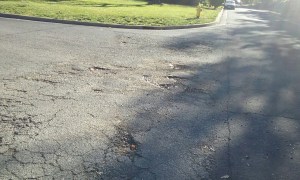
I took this picture of my street on the way home from the meeting.

So we’ve got developers paying fees, and residents paying property taxes – why do our streets look like this?

This is the “pedestrian right-of-way” down my street. Every now and then I look in that pothole, make sure there isn’t an old lady or a jogger with a stroller stuck down in there…

The entire street is becoming broken up and the asphalt has separated from the ground – you can hear it rumbling under your tires like old pottery as you pass over.

In Chico, as all of California, the government has been pouring the gas tax and other revenues that were supposed to be used to fix streets and roads into their pensions. At last Wednesday’s meeting, City of Chico finance mangler Scott Dowell said 15 percent of the “street and urbanization fees” collected from developers goes to “indirect costs” which he identified as “CalPERS.”  At the mention of CalPERS there were audible groans around the room, including committee members and $taff. Nobody wants to talk about CalPERS costs down there.

Sean Morgan complained the explanation “didn’t help.”  

City works employee Brendan Ottoboni said that if developers weren’t willing – in fact, I believe they have been threatening a lawsuit, given the little remarks made about letters being sent and meetings being had – Ottoboni says existing streets that are not “feeders” or do not have new projects built on them will be taken off the projects list.  Staffer Steve said they are still working with a list of projects identified in 2009, but never funded. A specific section of Rio Lindo, which Sean Morgan opined is “one of the worst streets in town,” has been removed from the list.

At this point local builder Bill Webb asked a pertinent question – “how do I get my street on the projects list…” Staffer Steve said, “of 14 projects identified in 2009 as FUNDED, 9 have been taken off the list…” for lack of funding.  “We’ve had a lot of requests for projects…” but the city only fixes streets “where there will be problems due to higher traffic” generated by new subdivisions. 

So here we are on my street, where the “current level of service” is, as one woman sitting near me described, “just crap.” My street is a very heavily used through street, new houses have been built every few lots over the last 20 years, and here’s the level of service we get from the city of Chico.

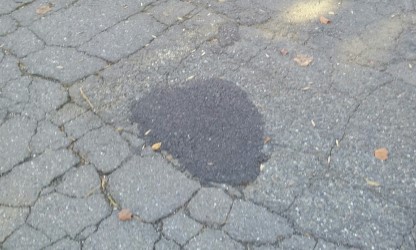
Every now and then a crew comes through and fills potholes with “slobbers” – asphalt left over from jobs in newer neighborhoods. We got that from the guy who was running the crew one day.

Here’s what a patch job like that looks like within a week.
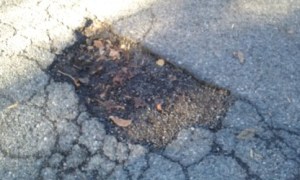
The asphalt they plopped in this old pothole took off on somebody’s tire.

The meeting ended with arguing, it was hard to hear what motion was made and passed. I believe they voted unanimously to “send the urbanization fees to council as described…” Chris Giampoli asked Brendan Ottoboni what would happen if the “urbanization fee” wasn’t approved by council, and Ottoboni answered “our road maintenance will continue to be unfunded.” He added, “new development…new growth…they use existing roads too…they don’t pay for them currently…”

To which Giampoli responded nastily, “people will continue to complain.” I’m not sure which people he’s talking about, but I’m feeling the beginnings of another lawsuit from the development community, one way or the other. We’ll see.  Years ago, Bill Webb’s dad and uncle and a few other developers sued the city for $500,000 in fees that had not been used for what they’d been collected, and won. 

Mark Sorensen, always politically incorrect, called the discussion a “Mexican stand-off.” So, that’s what we’ve got – a stand-off between the  city and the development community, with the good citizens standing right in the crossfire. 

POST SCRIPT:  Here’s an item from yesterday’s paper:

http://www.chicoer.com/government-and-politics/20171203/city-wants-to-improve-accessibility-of-lindo-channel-area

Apparently we have an Americans with Disabilities Act Citizen Committee – mentioned in this report:

http://chico-ca.granicus.com/MetaViewer.php?view_id=2&clip_id=609&meta_id=49208

a year ago, which extensively details our ADA deficiencies and how far behind we are complying with a law passed in 1990. 

I don’t know anything about this “committee” or how it was established, whether the Brown Act applies or what. I’ll have to snoop into it.


City of Lancaster issues a resolution in support of the Statewide Coalition to End Water Rate Abuse

2 Dec

Larry Grooms of the Water Rates Coalition sent me this news from the city of Lancaster in Southern California. 

See other news at their website here:  https://www.waterratescoalition.com/updates

RESOLUTION NO. 17-58

A RESOLUTION OF THE CITY COUNCIL OF THE CITY OF LANCASTER, CALIFORNIA, IN SUPPORT OF A STATEWIDE COALITION OF COMMUNITIES, UNDER THE WORKING TITLE OF COALITION TO END WATER RATE ABUSE, CALLING FOR THE INTRODUCTION AND PASSAGE OF STATEWIDE LEGISLATION TO REFORM THE RATEMAKING PROCESS FOR INVESTOR-OWNED, FOR-PROFIT WATER UTILITIES IN CALIFORNIA

WHEREAS, the California Public Utilities Commission’s (CPUC) Water Division regulates 113 investor-owned water and sewer utilities, servicing 16% of state residents, with 95% of that number being served by 9 large water utilities, each serving 10,000 or more connections, with annual revenues of $1.4 billion; and
WHEREAS, these investor-owned, for-profit water utilities charge water customer rates that are often three to five times higher than those charged by publicly-owned utilities, often directly adjacent to privately-owned systems; and
WHEREAS, in its rate cases, the CPUC is charged with protecting both the fiscal stability of the for-profit water utilities and the interests of ratepayers; and
WHEREAS, the CPUC’s Office of Ratepayer Advocates consistently favors the interests of investor-owned utilities over the interests of California residents and ratepayers; and
WHEREAS, this institutional and systematic imbalance has resulted in excessively high water rates, annual double-digit rate increases in water bills, and financial hardship to residents and homeowners throughout the state; and
WHEREAS, over the past decade, many cities and communities, including Lancaster, have sought relief for their residents through the CPUC, legislature, and/or courts, at significant cost and with little meaningful success.

NOW, THEREFORE, THE CITY COUNCIL OF THE CITY OF LANCASTER, CALIFORNIA, DOES HEREBY RESOLVE, DECLARE, DETERMINE AND ORDER AS FOLLOWS:

SECTION 1. That the Lancaster City Council supports statewide legislative reforms to the CPUC ratemaking process to achieve fair, equitable, and financially affordable rates for California customers of investor-owned, for-profit water utilities.

SECTION 2. That the Lancaster City Council supports the statewide Coalition to End Water Rate Abuse in its efforts to achieve fair and equitable protection for the rights of all ratepayers served by investor-owner, for-profit water utilities through legislative relief and/or class action litigation.

SECTION 3. That the goals of the Coalition to End Water Rate Abuse are consistent with the Lancaster City Council’s more than two-year-long effort to pursue equitable and fair relief for its residents served by the investor-owned, for-profit water utility, California Water Service Company.

PASSED, APPROVED and ADOPTED this 14 th day of November, 2017, by the following vote: Unanimous

Look at the WRC website link – State Senator Scott Wilk and Assemblyman Tom Lackey have written a letter questioning rate increases and WRAM – the “water rate adjustment mechanism” by which Cal Water punishes us for conserving too much. 

We’ve been asleep here ever since Cal Water’s bid to stick us in a district with Marysville and Oroville – raising our rates to cover their long-neglected infrastructure – was overturned by protests from the cities involved. Yes, City of Chico actually raised a finger to that maneuver, although, the public was never allowed in on that conversation.

 My family and our tenants have drastically cut our usage but our bills are still higher than they were two years ago. 

So, it’s time to write to your state representatives and ask them to join in on this inquiry. Quote the letter from Wilk and Lackey, and add some figures from your past water bills. 

Assemblyman Jim Gallagher – https://ad03.asmrc.org/

Senator Jim Nielsen –  http://nielsen.cssrc.us/

City should stop messing around in private enterprise

1 Dec

I made it to Wednesday’s Finance Committee meeting and I was not disappointed. There were several items on the agenda but the two discussions that interested me were variable fees for residential development – with “incentives” for high density – and “street urbanization” fees – and that turned out to be the real eye-opener.

T-shirt printer and new urban developer Dan Gonzales and his partners have been pushing the city to offer “incentives” – in the form of deferred and lower fees – for higher density projects. It started with Tom DiGiovanni of New Urban Builders getting the city to allow him to write a “parallel code” with lower setbacks and variances for the “footprint” of a home.  Under his code, the builder was allowed to take the walls of a home right to the edge of the lot, right to the edge of the public sidewalk. Some of the homes at  the Doe Mill subdivision have a back wall that actually serves as the “fence” to the neighbor’s yard – they just don’t put windows on that wall, how’s that for privacy?

Dan Gonzalez kept saying we needed smaller homes for “the workforce”  – I finally had to add, “We need jobs, is what we need for the workforce.” What we don’t need, are a bunch of slapped up 2 x 4’s covered in press board with bamboo flooring and “granite” countertops that end up pricing out at the top of the market. They told us Doe Mill was going to be “affordable.” It might be crap, but it’s not affordable to anybody in “the workforce,” if we even had a “workforce.” 

https://www.homes.com/for-sale/chico-ca/doe-mill/

Scott Gruendl, former Chico mayor and former head of Glenn County Health and Human Services had to rent bedrooms in his Doe Mill house to make it “affordable.” 

After Tom DiGiovanni built Doe Mill,   he got “Meriam Park” through the permits process using his “ ” Another name for DiGiovanni’s “parallel code” would be “sub-code” – that’s what they used to call it when a builder was granted variances to everything in the standard code. 

Why have a code? Ever been to an earthquake in Iran? 

Well, I’m going off at the mouth – the committee heard all about why they should do this and then Mark Sorensen summed it all up with “Nice try, but  take it out back and bury it…”  Mayor Sean Morgan had already made many comments indicating that he was not interested in going any further with the variable rate discussion. Randall Stone, a developer by trade, said he would “love to support” a variable rate but “we aren’t there yet…”   I think he meant by that, he’s stuck with a conservative majority on council and knows they won’t pass it. 

Why did they direct staff to study this issue for the last two years? If you have to give developers a discount rate, they’re peddling substandard goods. The market should be the incentive. Gonzalez claimed, “Look at the trends… the number of people per household is going down…women are having fewer children…” 

If that’s true, then the demand for his type of homes should be all the incentive he needs.  

The room was full of developers who didn’t want the variable rate because it was going to make the three to four bedroom houses they build unaffordable.

The government doesn’t have any business toying around in the free market. Our council changes with the wind – why would we give these people the power over changing our city and our quality of life so much? 

And the $taff time tied up in this discussion – they actually apologized to $taffer Brendan Ottoboni, who makes over $130,000 just in salary, to do the bidding of these idiots. But Ottoboni actually lobbied for the variable rate – saying, “I just want to do the right thing…”    Who is he “doing the right thing” for? Knowing fully well that while the rate would be lower for high density units in the beginning, the property tax profits for the city would be huge and go on forever. 

I’ll get back to the “urbanization and street fees” next time, on this old blog with Juanita.